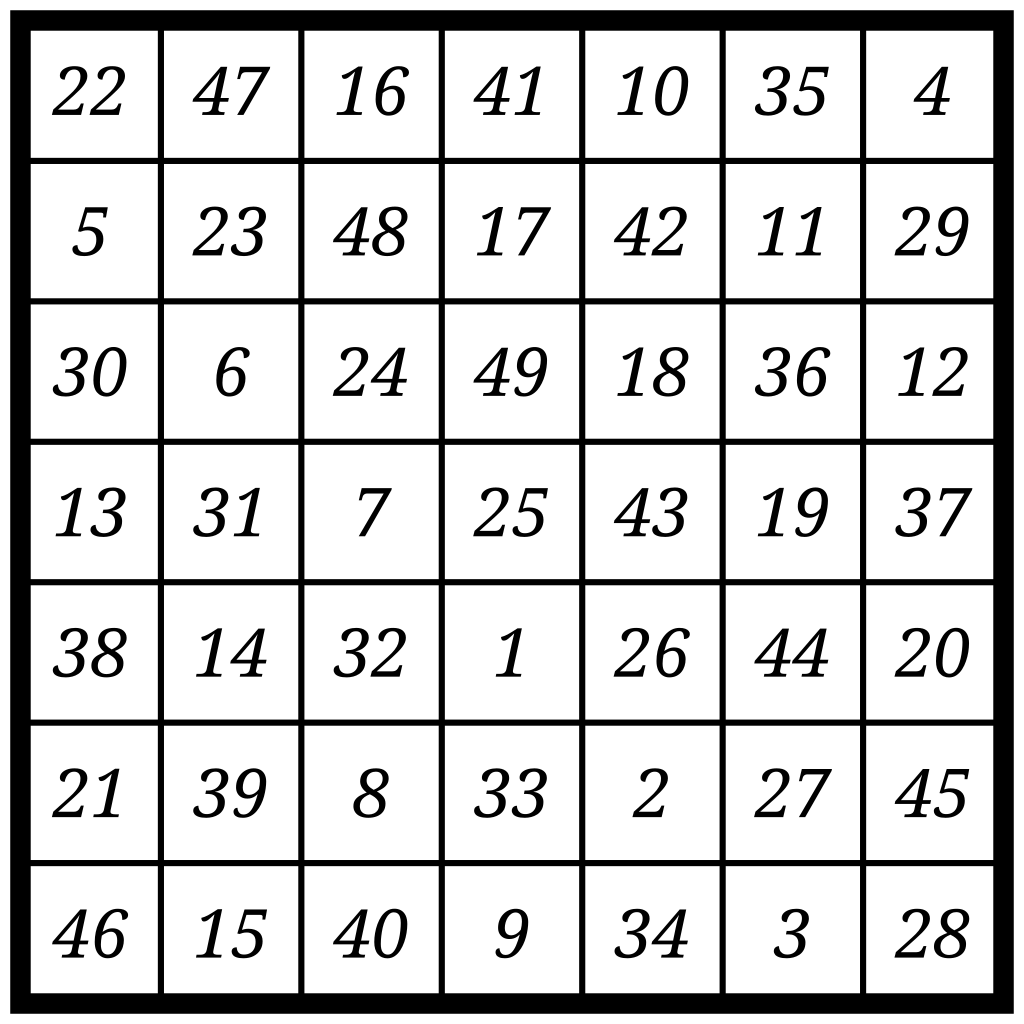
A magic square of 7 by 7: the numbers 1 to 49, set so that every row, every column and both diagonals add up to 175, and all of them together to 1225.
- Order
- 7 × 7
- Numbers
- 1–49
- Each line
- 175
- The whole square
- 1225
How the square is made
Agrippa's square is the one this rule makes: 1 goes in the cell just below the centre, and each next number one cell down and one to the right, wrapping round at the edges, or two cells down where that cell is taken.
The square in print
Agrippa prints the square in De occulta philosophia (Cologne, 1533), book II, chapter 22, on page CLI, in numbers and again in Hebrew letters, with the planet's seal and the characters of its intelligence, its spirit and its intelligences, the Bne Seraphim. Regardie's plates in The Golden Dawn, volume 4 (1940), draw it again, on page 84. The square here is Agrippa's with the slip of the 1533 printing noted below corrected; whether it is the author's or the printer's, the evidence read does not settle.
The names of the square
Agrippa gives each square names whose letters add up to one of its numbers: its order, its count of cells, the sum of a line or the sum of the whole. The divine names come first, then the intelligence and the spirit. The Hebrew is Agrippa's of 1533, the spelling this site traces; under each name is every witness's reading, linked to its page, with its own spelling where it differs. A name with a page of its own has its sigil there, traced on this square.
| Name | Hebrew | Number |
|---|---|---|
| Divine name Aha | אהא | 7the square's order |
| Intelligence Hagiel | הגיאל | 49the square's count of cells |
| Spirit Kedemel | קדמאל | 157 |
| ||
| Intelligences Bne Seraphim | בני שרפים | 1225the sum of the square |
| ||
The seal
The planet's seal, after Agrippa's woodcut on page CLI of the 1533 printing: our own drawing of its lines, not a copy of the print. Regardie describes a planet's seal as a figure drawn so as to touch each of the square's numbers (page 80).
See also
- The planet's correspondences
- The temple hall that has this square in it: Philosophus Temple in Netzach
- Trace any Hebrew name on this square in the kamea sigil generator, by the method Regardie sets out in The Golden Dawn, volume 4, on pages 78 to 80.
- All seven kameas