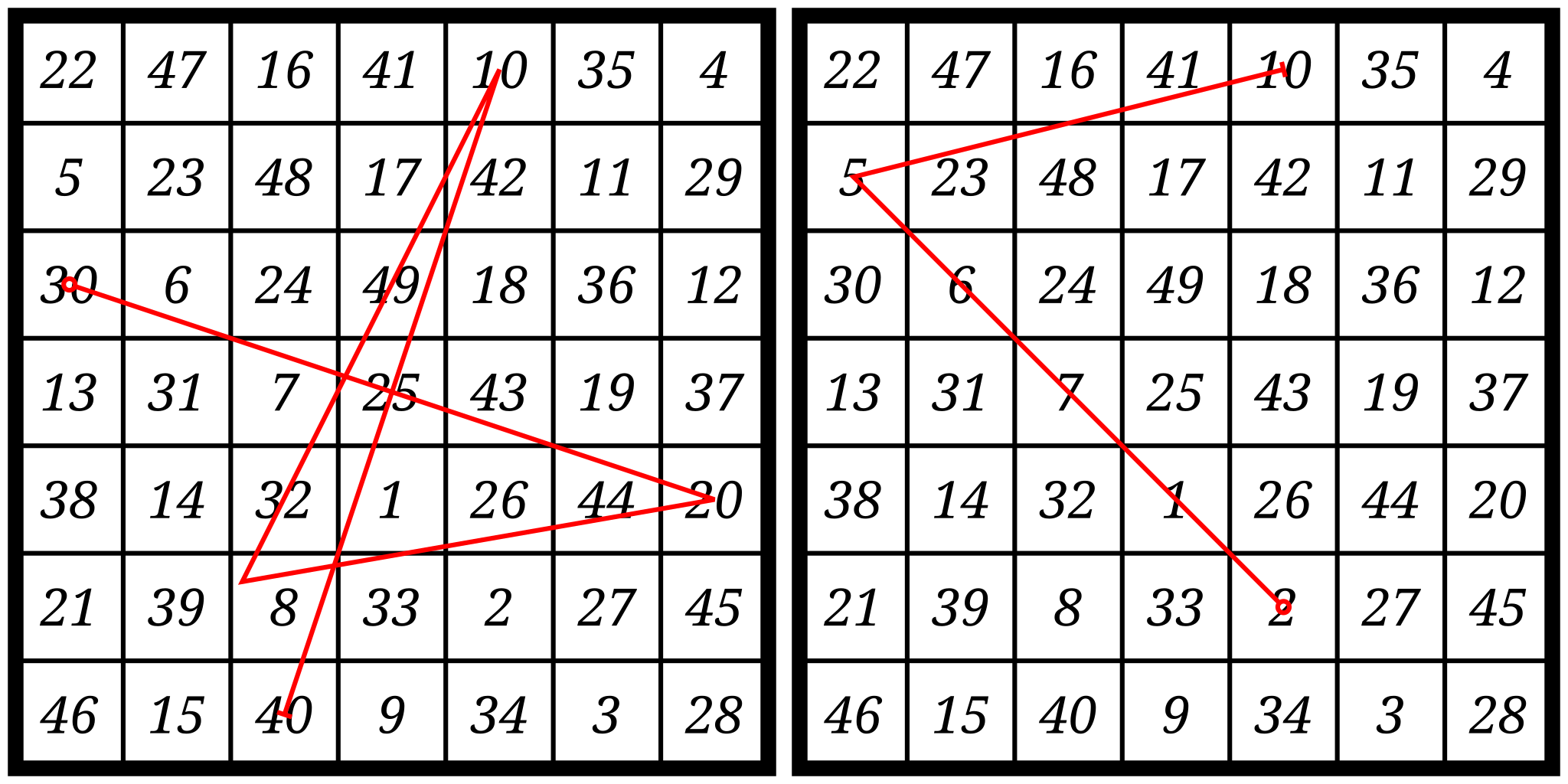
The intelligences of Venus, in Agrippa's plural.
| Name | Bne Seraphim |
|---|---|
| Hebrew | בני שרפים as Agrippa prints it in 1533 |
| Number | 1225, the sum of the squareIts letters give 692; Agrippa 1533's reading below says why. |
| Kamea | Kamea of Venus |
Each printing's reading of the name, linked to its page: its romanisation or caption, its own spelling where it is not Agrippa's of 1533, and the number it prints, with what its letters give where that differs and whose the difference is.
Intelligentiae Veneris, 1225. The plate of Venus' seals (n166) labels its sigil Intelligentiarum Veneris. Prints 1225, where its letters give 692. Whose the difference is, the evidence read does not settle. 1225 is the sum of Venus' square, which the name does not reach by any count: 692, or 1252 with the final mem at 600, which is 1225 with two digits swapped. Whether Agrippa gave the name the square's number regardless, or 1252 was meant and transposed, the 1533 page does not show; an earlier witness to the table would.The Intelligencies of Venus, 1252 with the final letters at 500 to 900. 1252 is the sum with the final mem at 600, and also 1533's 1225 with two digits swapped: whether the translator counted the final or the compositor transposed the number, the page does not show.the Intelligence of Venus, 1225. Prints 1225, where its letters give 692. Whose the difference is, the evidence read does not settle. 1533's number against 1651's 1252, which Barrett otherwise follows: whether he took it from a Latin edition or restored the square's sum himself is not shown.The sigil traces the name's letters on its planet's kamea by the method Regardie sets out in The Golden Dawn, volume 4 (1940), on pages 78 to 80: each letter is counted at its number, a number the square does not have is taken down to its tens or its units, and a line runs through the cells in the order of the letters, from a small circle at the first. The spelling traced is Agrippa's of 1533, with any final letter at its ordinary value.
| Letter | Number | Cell |
|---|---|---|
| Word 1 בני | ||
| ב | 2 | 2 |
| נ | 50 | 5 |
| י | 10 | 10 |
| Word 2 שרפים | ||
| ש | 300 | 30 |
| ר | 200 | 20 |
| פ | 80 | 8 |
| י | 10 | 10 |
| ם | 40 | 40 |
Agrippa prints a character for the name beside its planet's square, on page CLI of the 1533 printing, which is in the public domain. Below is the character redrawn from our reading of the woodcut, not a copy of the print.
Our reading: it is the trace of בני שרפים on the square, drawn freely. That trace counts the final letters at 500 to 900.
Its marks: One stroke a word, each with a circle at its start and a blunt end. The final ם counts 600, on cell 6; the last leg is short.
Regardie's plates in The Golden Dawn, volume 4 (1940), draw the character again, on page 84. That book is in copyright where this site is read, so his figure is neither shown nor redrawn here; this is our reading of it.
Our reading: it is the trace of בני שרפים on the square, drawn freely. That trace counts the final letters at 500 to 900.
Its marks: A circle at each word's start, the ends plain. The final ם on cell 6; the last leg stops well short of it.
How this was read: each figure was cropped from the scan and given a number in place of its name. Two readers, Claude Opus 5.5 and Claude Fable 5.2, working apart, recorded its strokes, the points along them and the marks at their ends. Two judges, the same two models working apart, then compared each figure and both readings with the trace of every witness's spelling. Where the judges agreed, their verdict stands; where they differed, on 7 of the 32 figures, Claude Opus 5.5 weighed both judges' reasons against the figure and settled it, and the note with the verdict says how. The readings and verdicts are in the table of Agrippa's characters.