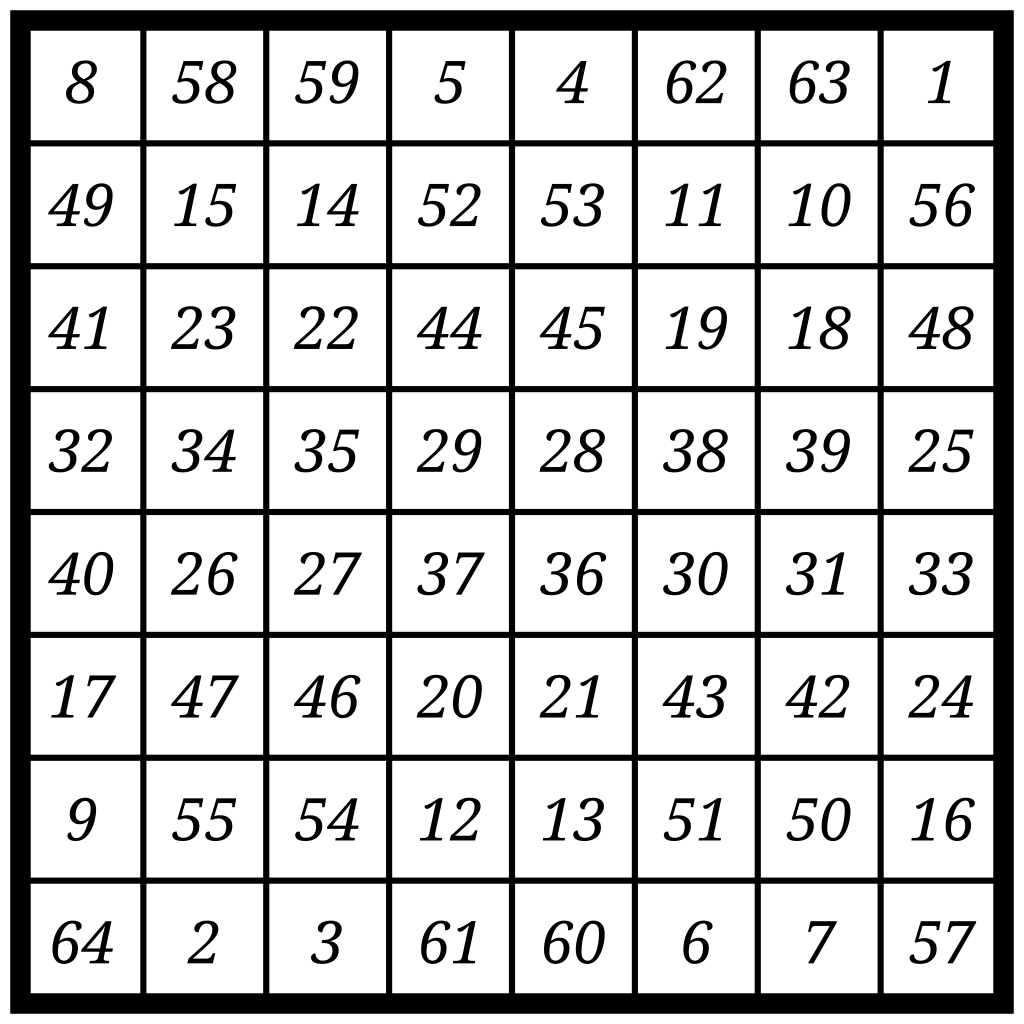
A magic square of 8 by 8: the numbers 1 to 64, set so that every row, every column and both diagonals add up to 260, and all of them together to 2080.
- Order
- 8 × 8
- Numbers
- 1–64
- Each line
- 260
- The whole square
- 2080
How the square is made
Agrippa's square is the one this rule makes: write the numbers 1 to 64 in order, row by row; exchange every number on a diagonal of each four-by-four block for 65 less that number; then read the rows from the bottom up.
The square in print
Agrippa prints the square in De occulta philosophia (Cologne, 1533), book II, chapter 22, on page CLII, in numbers and again in Hebrew letters, with the planet's seal and the characters of its intelligence and its spirit. Regardie's plates in The Golden Dawn, volume 4 (1940), draw it again, on page 85. The square here is Agrippa's as the 1533 printing gives it.
- Agrippa's Hebrew table leaves the cell of 10 blank. page CLII
- Regardie's volume 4 swaps three pairs of numbers: 45 and 48 in row 3, and 35 and 38, and 25 and 28, in row 4. Its rows still add up to 260; its columns do not. None of the swapped cells is one that Taphthartharath's sigil passes through. page 85
The names of the square
Agrippa gives each square names whose letters add up to one of its numbers: its order, its count of cells, the sum of a line or the sum of the whole. The divine names come first, then the intelligence and the spirit. The Hebrew is Agrippa's of 1533, the spelling this site traces; under each name is every witness's reading, linked to its page, with its own spelling where it differs. A name with a page of its own has its sigil there, traced on this square.
| Name | Hebrew | Number |
|---|---|---|
| Divine name Asboga | אזבוגה | 8 for each pair of its lettersthe square's order |
| Divine name Din | דין | 64the square's count of cells |
| Divine name Doni | דני | 64the square's count of cells |
| Intelligence Tiriel | טיריאל | 260the sum of a line |
| ||
| Spirit Taphthartharath | תפתרתרת | 2080the sum of the square |
| ||
The seal
The planet's seal, after Agrippa's woodcut on page CLII of the 1533 printing: our own drawing of its lines, not a copy of the print. Regardie describes a planet's seal as a figure drawn so as to touch each of the square's numbers (page 80).
See also
- The planet's correspondences
- Trace any Hebrew name on this square in the kamea sigil generator, by the method Regardie sets out in The Golden Dawn, volume 4, on pages 78 to 80.
- All seven kameas