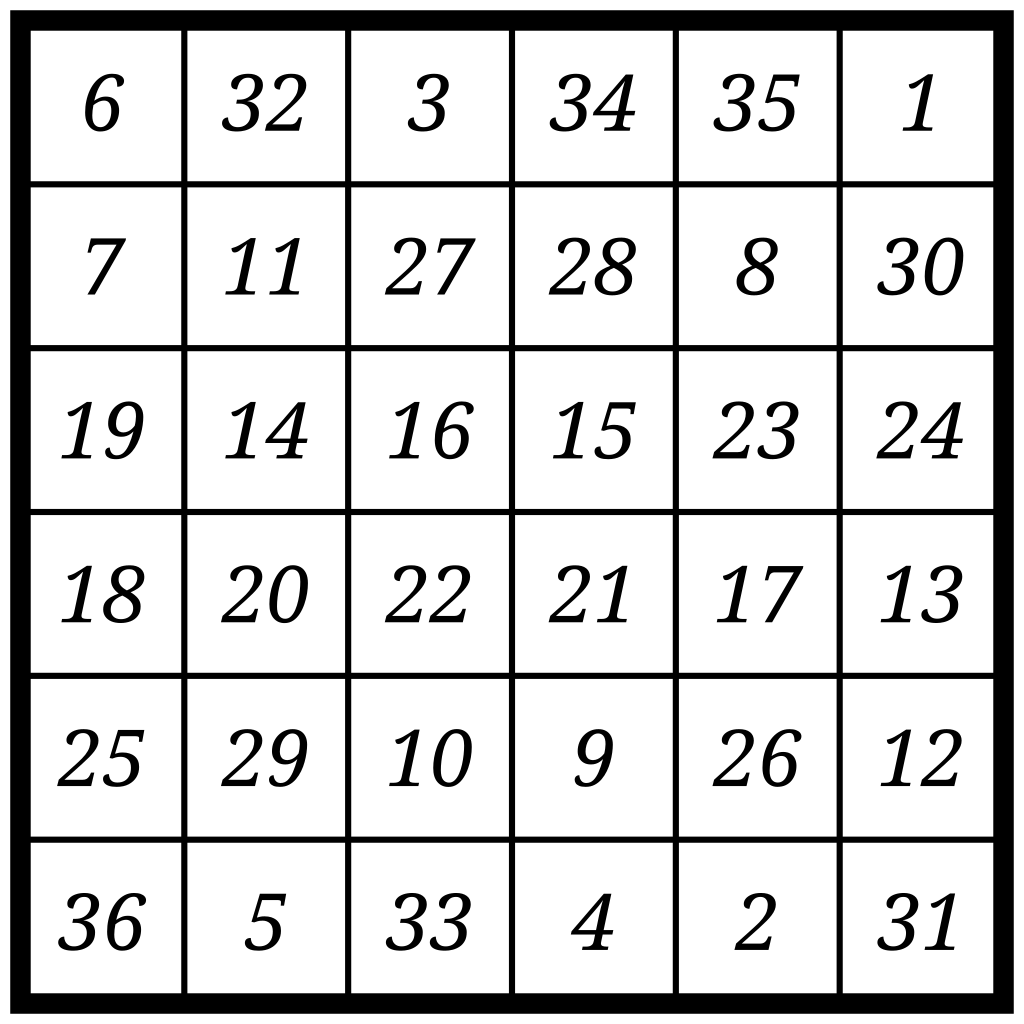
A magic square of 6 by 6: the numbers 1 to 36, set so that every row, every column and both diagonals add up to 111, and all of them together to 666.
- Order
- 6 × 6
- Numbers
- 1–36
- Each line
- 111
- The whole square
- 666
How the square is made
No rule as simple as the odd squares' or those of four and eight makes a square of six, and the square here is Agrippa's as he prints it.
The square in print
Agrippa prints the square in De occulta philosophia (Cologne, 1533), book II, chapter 22, on page CL, in numbers and again in Hebrew letters, with the planet's seal and the characters of its intelligence and its spirit. Regardie's plates in The Golden Dawn, volume 4 (1940), draw it again, on page 83. The square here is Agrippa's as the 1533 printing gives it.
The names of the square
Agrippa gives each square names whose letters add up to one of its numbers: its order, its count of cells, the sum of a line or the sum of the whole. The divine names come first, then the intelligence and the spirit. The Hebrew is Agrippa's of 1533, the spelling this site traces; under each name is every witness's reading, linked to its page, with its own spelling where it differs. A name with a page of its own has its sigil there, traced on this square.
| Name | Hebrew | Number |
|---|---|---|
| Divine name Vau | ו | 6the square's order |
| Divine name He extensum | הא | 6the square's order |
| Divine name Eloh | אלה | 36the square's count of cells |
| ||
| Intelligence Nakhiel | נכיאל | 111the sum of a line |
| Spirit Sorath | סורת | 666the sum of the square |
| ||
The seal
The planet's seal, after Agrippa's woodcut on page CL of the 1533 printing: our own drawing of its lines, not a copy of the print. Regardie describes a planet's seal as a figure drawn so as to touch each of the square's numbers (page 80).
See also
- The planet's correspondences
- Trace any Hebrew name on this square in the kamea sigil generator, by the method Regardie sets out in The Golden Dawn, volume 4, on pages 78 to 80.
- All seven kameas