The spirit of Mercury.
| Name | Taphthartharath |
|---|---|
| Hebrew | תפתרתרת as Agrippa prints it in 1533 |
| Number | 2080, the sum of the square |
| Kamea | Kamea of Mercury |
Each printing's reading of the name, linked to its page: its romanisation or caption, its own spelling where it is not Agrippa's of 1533, and the number it prints, with what its letters give where that differs and whose the difference is.
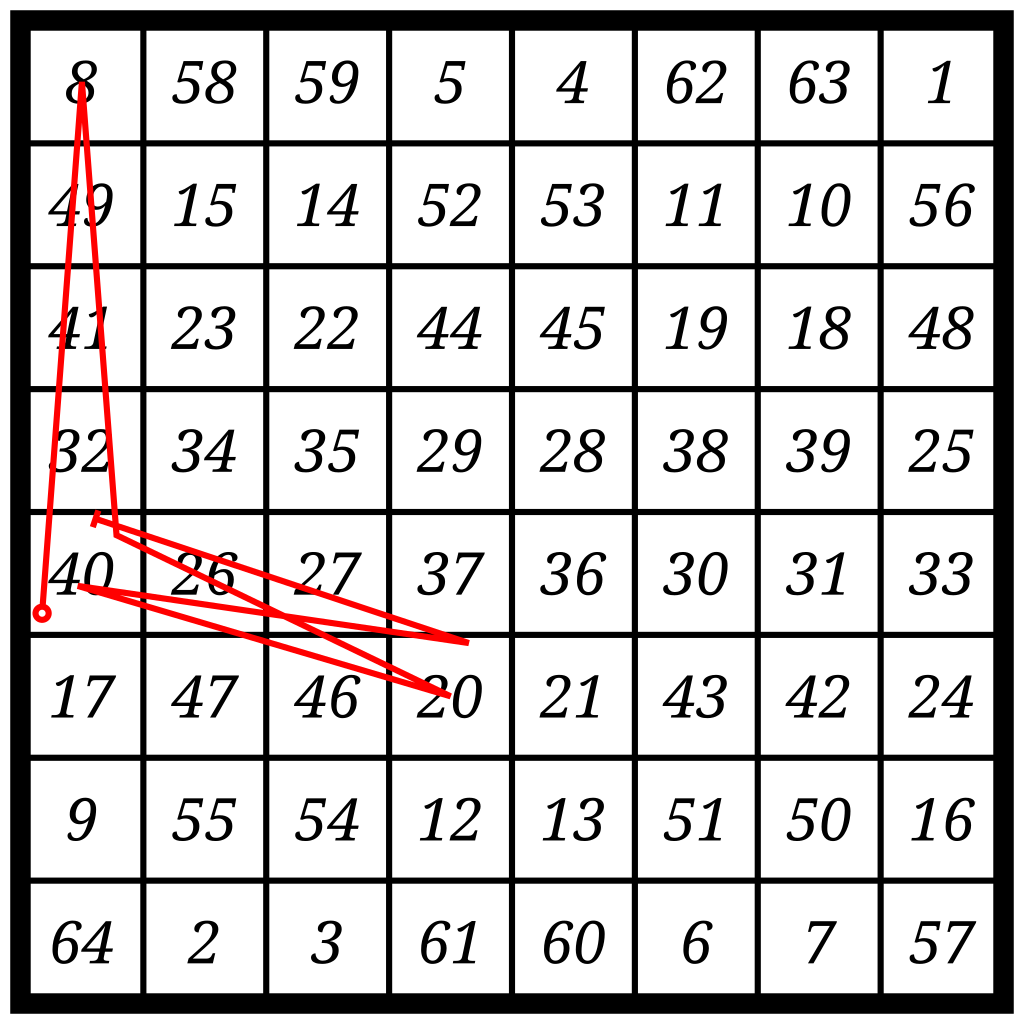
Daemonium Mercurij, 2080The spirit of Mercury, תפתרתדת, 2080. Read in the EEBO copy, where the sixth letter is a dalet. In b30335231 (n256) the letter is unclear, so whether this is the edition's reading or a damaged sort in one copy is not settled. Prints 2080, where its letters give 1884. Whose the difference is, the evidence read does not settle. The EEBO copy prints a dalet for the sixth letter, 1533's second resh; b30335231 is unclear there. Reading that letter in b30335231 or a third copy would settle whether the edition or one copy has it; Barrett, who follows 1651 elsewhere, has the resh.The sigil traces the name's letters on its planet's kamea by the method Regardie sets out in The Golden Dawn, volume 4 (1940), on pages 78 to 80: each letter is counted at its number, a number the square does not have is taken down to its tens or its units, and a line runs through the cells in the order of the letters, from a small circle at the first. The spelling traced is Agrippa's of 1533, with any final letter at its ordinary value.
| Letter | Number | Cell |
|---|---|---|
| ת | 400 | 40 |
| פ | 80 | 8 |
| ת | 400 | 40 |
| ר | 200 | 20 |
| ת | 400 | 40 |
| ר | 200 | 20 |
| ת | 400 | 40 |
Agrippa prints a character for the name beside its planet's square, on page CLII of the 1533 printing, which is in the public domain. Below is the character redrawn from our reading of the woodcut, not a copy of the print.
Our reading: it is the trace of תפתרתרת on the square, drawn freely.
Its marks: None: the trace ends where it starts and the figure is a closed outline, the returns drawn as parallel prongs.
Regardie's plates in The Golden Dawn, volume 4 (1940), draw the character again, on page 85. That book is in copyright where this site is read, so his figure is neither shown nor redrawn here; this is our reading of it.
Our reading: it is the trace of תפתרתרת on the square, drawn freely.
Its marks: None: a closed outline, as 1533.
How this was read: each figure was cropped from the scan and given a number in place of its name. Two readers, Claude Opus 5.5 and Claude Fable 5.2, working apart, recorded its strokes, the points along them and the marks at their ends. Two judges, the same two models working apart, then compared each figure and both readings with the trace of every witness's spelling. Where the judges agreed, their verdict stands; where they differed, on 7 of the 32 figures, Claude Opus 5.5 weighed both judges' reasons against the figure and settled it, and the note with the verdict says how. The readings and verdicts are in the table of Agrippa's characters.
Where another witness spells the name so that it traces otherwise, and no note above calls that spelling a slip, its trace too, by the same method.
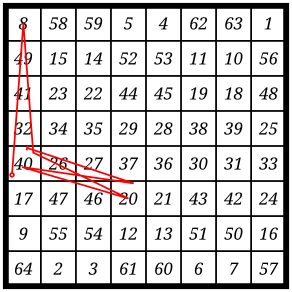
Agrippa 1651: תפתרתדת Open in the generator
Whose this spelling is, the evidence read does not settle: The EEBO copy prints a dalet for the sixth letter, 1533's second resh; b30335231 is unclear there. Reading that letter in b30335231 or a third copy would settle whether the edition or one copy has it; Barrett, who follows 1651 elsewhere, has the resh.
| Letter | Number | Cell |
|---|---|---|
| ת | 400 | 40 |
| פ | 80 | 8 |
| ת | 400 | 40 |
| ר | 200 | 20 |
| ת | 400 | 40 |
| ד | 4 | 4 |
| ת | 400 | 40 |