The spirit of spirits of the Moon.
| Name | Schedbarschemoth Schartathan |
|---|---|
| Hebrew | שדברשהמעתשרתתן as Agrippa prints it in 1533 |
| Number | 3321, the sum of the squareWith the final letters counted at 500 to 900. |
| Kamea | Kamea of the Moon |
Each printing's reading of the name, linked to its page: its romanisation or caption, its own spelling where it is not Agrippa's of 1533, and the number it prints, with what its letters give where that differs and whose the difference is.
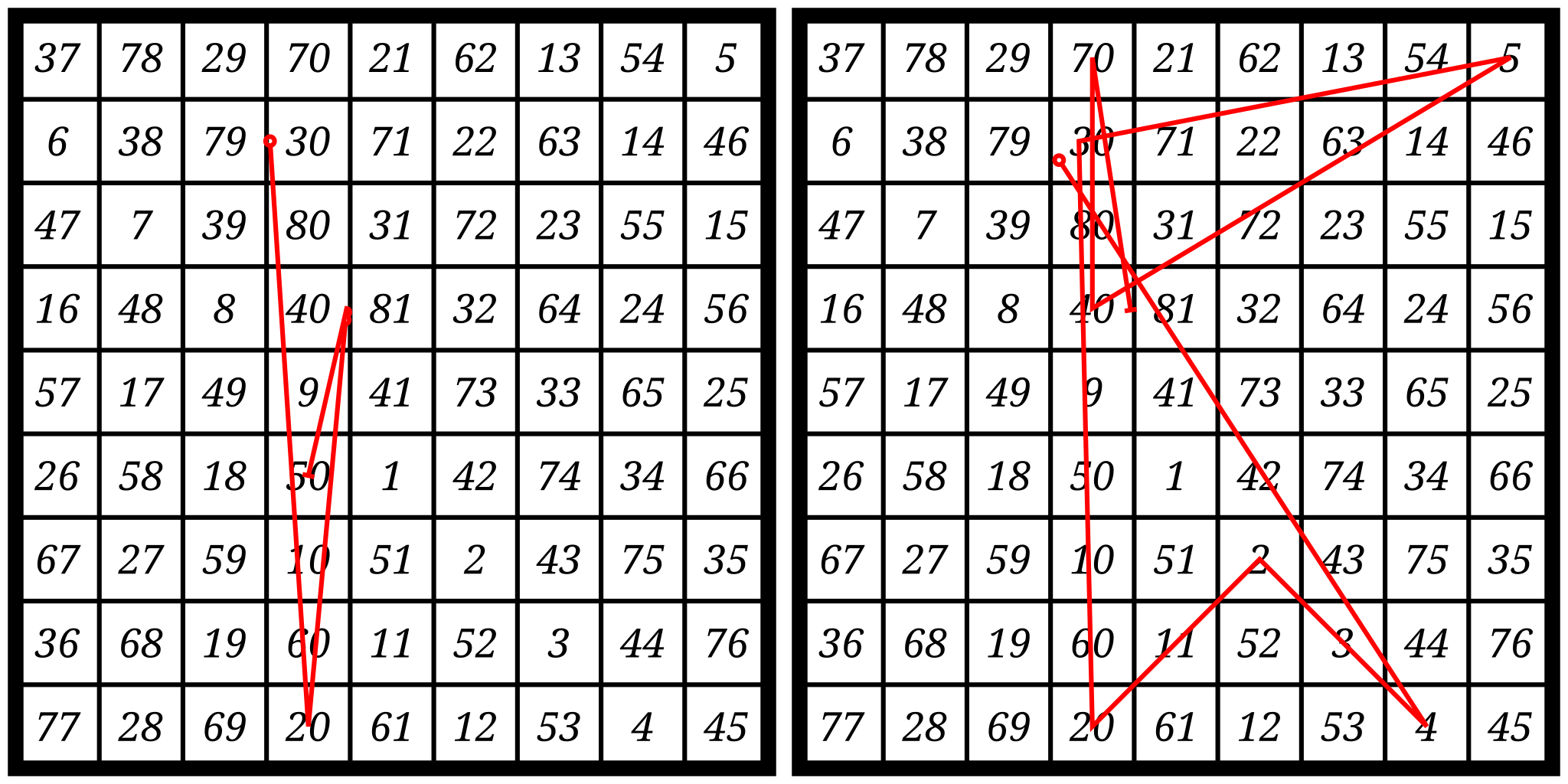
Daemonium daemoniorum Lunae, 3321 with the final letters at 500 to 900the spirit of the spirits of the Moon, שדברשהמעה שרתתו, 3321. Printed as two words; the same in both copies. Prints 3321, where its letters give 2232. A slip of this printing, its author's or its printer's. A he for 1533's ninth letter, tav, and a vav for its final nun; 1533's spelling gives 3321 with the final nun at 700.the Spirit of the Spirits, שדברשהמעחשרתתו, 3321. Prints 3321, where its letters give 2235. Taken over from Agrippa 1651. 1651's vav for the final nun, and a heth where 1651 has its he (1533's tav): the heth is Barrett's own.The sigil traces the name's letters on its planet's kamea by the method Regardie sets out in The Golden Dawn, volume 4 (1940), on pages 78 to 80: each letter is counted at its number, a number the square does not have is taken down to its tens or its units, and a line runs through the cells in the order of the letters, from a small circle at the first. The spelling traced is Agrippa's of 1533, with any final letter at its ordinary value.
Agrippa prints it as one word of fourteen letters. Dividing it in two, where its romanisation divides it, is ours, and is how this site traces it.
| Letter | Number | Cell |
|---|---|---|
| Word 1 שדברשהמעת | ||
| ש | 300 | 30 |
| ד | 4 | 4 |
| ב | 2 | 2 |
| ר | 200 | 20 |
| ש | 300 | 30 |
| ה | 5 | 5 |
| מ | 40 | 40 |
| ע | 70 | 70 |
| ת | 400 | 40 |
| Word 2 שרתתן | ||
| ש | 300 | 30 |
| ר | 200 | 20 |
| ת | 400 | 40 |
| ת | 400 | 40 |
| ן | 50 | 50 |
Agrippa prints a character for the name beside its planet's square, on page CLIII of the 1533 printing, which is in the public domain. Below is the character redrawn from our reading of the woodcut, not a copy of the print.
Our reading: it is not recognisably the trace of any spelling; the nearest is שדברשהמעת שרתתן. That trace counts the final letters at 500 to 900.
Where it departs from that trace:
Its marks: Circles at most free ends, a ring on the oval, a wedge at one end.
The judges differ: one finds no trace; the other a partial one that needs a joined ש and ה (near cell 35), an extra pen lift and an unexplained loop. Recorded as no: that many unattested steps do not make a recognisable trace.
Regardie's plates in The Golden Dawn, volume 4 (1940), draw the character again, on page 86. That book is in copyright where this site is read, so his figure is neither shown nor redrawn here; this is our reading of it.
Our reading: it is not recognisably the trace of any spelling; the nearest is שדברשהמעת שרתתן. That trace counts the final letters at 500 to 900.
Where it departs from that trace:
Its marks: As 1533, with a fork for the wedge.
The judges differ as for 1533; recorded the same way.
How this was read: each figure was cropped from the scan and given a number in place of its name. Two readers, Claude Opus 5.5 and Claude Fable 5.2, working apart, recorded its strokes, the points along them and the marks at their ends. Two judges, the same two models working apart, then compared each figure and both readings with the trace of every witness's spelling. Where the judges agreed, their verdict stands; where they differed, on 7 of the 32 figures, Claude Opus 5.5 weighed both judges' reasons against the figure and settled it, and the note with the verdict says how. The readings and verdicts are in the table of Agrippa's characters.